Pruning
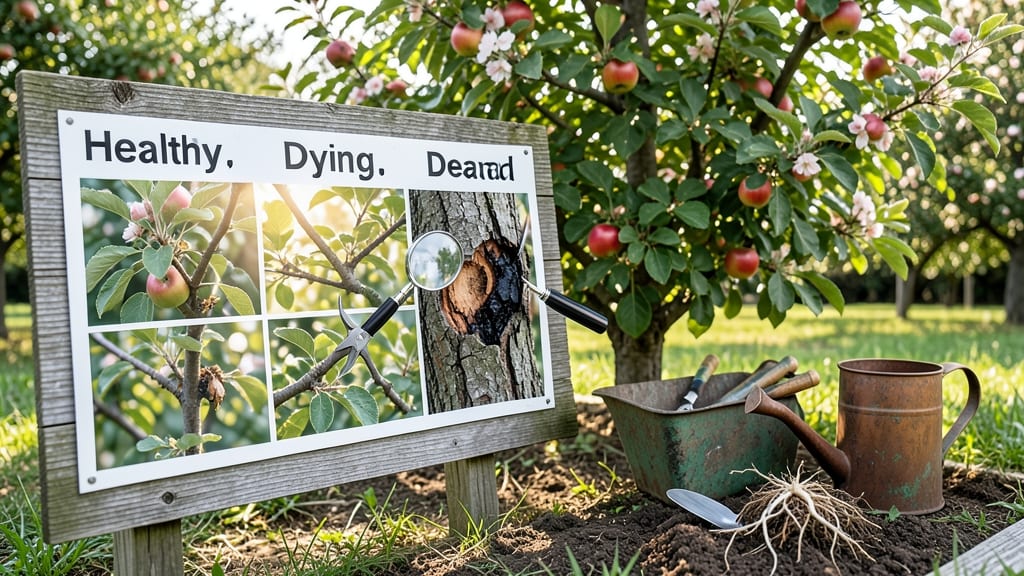
Determining if your apple tree is dead requires checking for five definitive signs: completely bare branches, absence of buds or leaf scars, severely cracked or peeling bark exposing dry wood, no response to scratching tests, and a hollow trunk with no green tissue inside. Always double-check before making assumptions.
Apple trees can be tricky to diagnose—what looks like dormancy might actually be death. 🌳 The key difference lies in the tree's internal health: live trees show green tissue when you cut into branches, while dead ones reveal brown, crumbly wood.
I've seen many gardeners mistake winter dormancy for death, so always wait until spring to confirm if you're unsure. Even if your tree appears lifeless now, checking for these signs in early spring can save it from an unnecessary replacement.
For example, a tree with cracked bark might still be alive if the cracks aren't exposing dry wood, as bark damage can sometimes heal. The scratch test is particularly telling—if you scrape the bark and see green underneath, the tree's still fighting.
When in doubt, dig near the base to check for live roots, which often indicate the tree might still recover with proper care.
💡 In This Article
- 5 Critical Signs Your Apple Tree Is Actually Dead
- What to Do If Your Apple Tree Is Dead (Or Just Dormant)
5 Critical signs your apple tree is actually dead
When diagnosing a dead apple tree, the first clue lies in its branches. A truly dead tree will have completely bare branches with no buds or leaf scars, even in early spring.
These buds are like the tree's survival switches—when they fail to swell, it means the vascular system has collapsed. Think of it as a plumbing failure: without water transport, the tree can't sustain life.
In contrast, a dormant tree might have tiny buds or scars, showing it's just conserving energy for spring.
The bark tells another critical story. Healthy bark should be firm with a smooth or slightly rough texture, but dead trees often show cracked or peeling bark exposing dry, brown wood underneath. This happens when the cambium layer—responsible for producing new cells—dies off.
The cambium acts like a tree's growth ring factory, and without it, the tree can't repair itself. For example, if you see vertical cracks wider than 1/4 inch with no green tissue beneath, that's a red flag.
Even if some bark remains intact, if it's brittle and flakes off easily, the tree's likely beyond saving.
A definitive test is the scratch test, where you gently scrape the bark to expose the cambium layer. Live trees reveal green tissue beneath, indicating active growth. Dead trees show only brown, crumbly wood. This test works because the cambium contains chlorophyll—when it's alive, it stays green.
I've seen gardeners accidentally kill trees by assuming winter dormancy meant death, only to discover green cambium in spring. Always wait until late winter or early spring for this test to avoid false positives.
The trunk's condition offers final confirmation. A hollow trunk with no green tissue when cut open means the tree's internal structure has completely decayed. This happens when fungi or bacteria consume the wood from the inside out, leaving only a shell.
You might also notice a foul odor or sawdust-like debris at the base—signs of advanced decay. Even if the outer bark looks intact, if the center is hollow, the tree is dead.
This decay process can take years, so a suddenly hollow trunk suggests a recent fatal infection or physical damage.
Seasonal confusion often leads to misdiagnosis. Apple trees naturally drop leaves in winter, but they should still have buds or leaf scars along the branches. In spring, check for swollen buds—these are the tree's promise of new growth.
If you see none, even after warm weather, the tree's likely dead. One exception: some varieties like 'Granny Smith' are late bloomers, so wait until mid-April in most climates before declaring a tree dead. Patience here can save you from prematurely replacing a still-living tree.
Consider these additional clues: No new shoots from the base or roots, yellowing or wilting leaves that don't recover, and insect infestations like bark beetles that target weakened trees. These signs often appear before the tree completely dies, giving you a window to act.
For example, a sudden infestation of woodpeckers drilling into the bark is a classic sign of beetle activity—another indicator the tree's struggling to survive.