
Trees
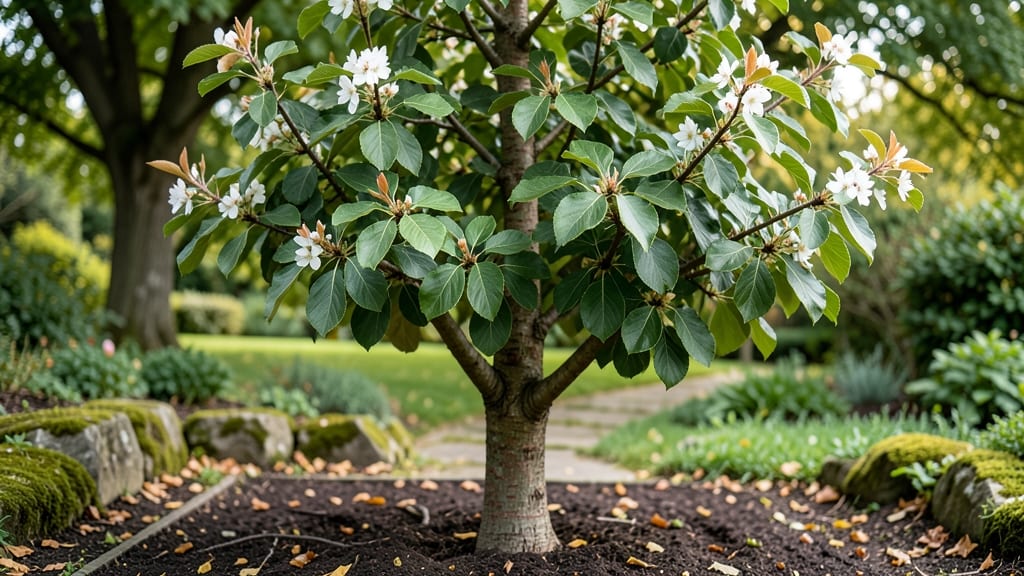
Pear tree leaves look like elongated ovals with smooth, glossy dark green tops and paler undersides, featuring jagged edges and a sharp point at the tip. They grow singly along branches, typically 2 to 4 inches long, with a slightly waxy sheen.
These leaves are one of the easiest ways to distinguish pear trees from their close relatives. 🌿 Unlike apple leaves, which often have more pronounced teeth and a slightly rougher texture, pear leaves are smoother and more uniform in shape.
The alternating arrangement along branches also helps—you won't find them clustered like some ornamental trees. I always check for these three key traits when identifying a tree in my yard: the glossy finish, the serrated edges, and that classic elongated shape.
What's interesting is how these leaves change with the seasons. In spring, they emerge a lighter green and gradually darken as they mature. By late summer, the waxy coating becomes more noticeable, especially after rain, which helps repel water and pests.
This subtle sheen is a dead giveaway for experienced gardeners trying to spot a young pear tree.
💡 In This Article
- Distinctive Leaf Features of Pear Trees
- How to Identify Pear Trees Using Leaf Characteristics
Distinctive leaf features of pear trees
Pear tree leaves have a unique combination of shape and texture that sets them apart from other fruit-bearing trees. Their oval to elliptical shape is typically 2 to 4 inches long and 1 to 2 inches wide, with a distinctive pointed tip that tapers gradually.
The edges feature fine, sharp serrations—about 10-15 teeth per inch—that create a saw-like appearance when viewed closely. These serrations are more delicate than those on apple leaves, which tend to be broader and more irregular.
The most striking visual feature is the glossy dark green upper surface that reflects light, giving them a slightly waxy sheen. This coating isn't just for show—it's a natural cutin layer that helps reduce water loss and repels pests.
The undersides are a lighter, pale green to yellowish hue, often with a faint downy fuzz when young. 🌿 What's fascinating is how this texture evolves: juvenile leaves (on new growth) are softer and more velvety, while mature leaves develop a firmer, almost leathery consistency by midsummer.
When examining the veins, you'll notice a prominent central vein with 6-8 secondary veins on each side that arch gently toward the leaf edges. This vein pattern creates a delicate network that's more uniform than the more chaotic branching seen in cherry leaves.
The alternating arrangement—where each leaf grows at a different angle from the branch—is another key identifier, as many ornamental trees have clustered or opposite leaf patterns.
Comparing pear leaves to their close relatives reveals subtle but important differences. Apple leaves, for instance, tend to be more oblong with coarser serrations and a slightly rougher texture. Cherry leaves are narrower, with more pronounced teeth and a duller finish.
The waxy sheen of pear leaves is particularly noticeable after rainfall, when water beads up and rolls off like tiny mercury droplets—a trait shared with some citrus leaves but rare in fruit trees.
Seasonal variations provide additional clues. In spring, new leaves emerge a bright lime green and are slightly cupped, while summer leaves develop their mature deep forest green hue. By autumn, they turn a soft yellow (rather than the fiery reds of maples) before dropping.
This gradual color change helps distinguish them from deciduous trees that undergo more dramatic seasonal shifts.
For gardeners, understanding these features is crucial when distinguishing between common lookalikes. Hawthorn leaves, for example, have lobed edges and grow in clusters, while crabapple leaves are more rounded with shallower serrations.
The combination of glossy surface, fine serrations, and waxy texture makes pear leaves one of the most distinctive in orchards and landscapes.