
Plants
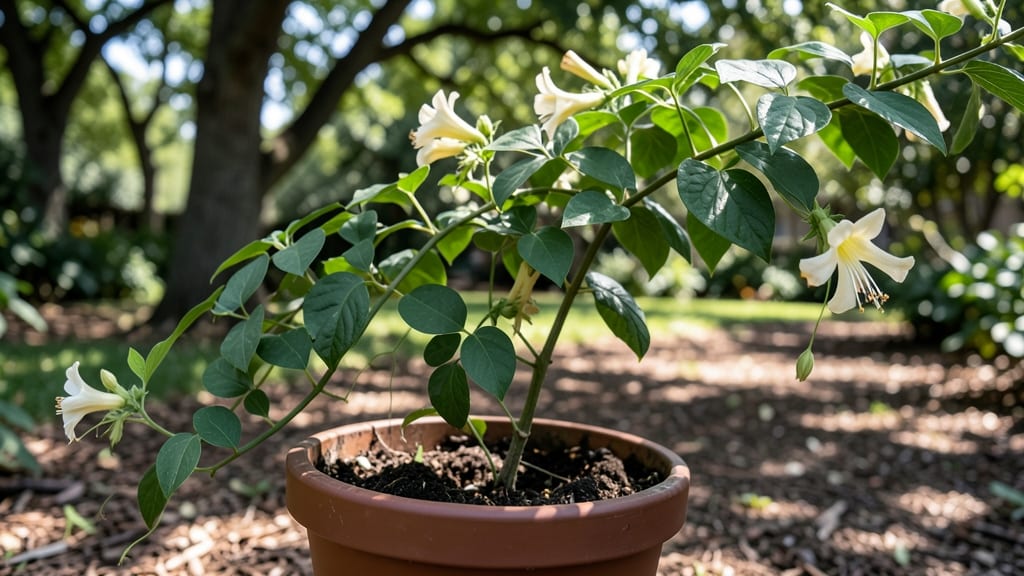
A honeysuckle tree looks like a fast-growing vine with glossy, oval leaves arranged in opposite pairs along woody stems. Its signature tubular flowers bloom in fragrant clusters of white, yellow, or pink, while young bark stays smooth and greenish before developing rougher texture as it matures. These deciduous climbers can stretch 20–30 feet with graceful arching branches.
A honeysuckle tree's most striking feature is its opposite leaf arrangement, where pairs of glossy, oval leaves grow directly across from each other on the stem. 🌿 The flowers—tubular, trumpet-shaped, and highly aromatic—are a dead giveaway, often attracting hummingbirds and butterflies with their sweet nectar.
Unlike some invasive varieties, native honeysuckles maintain a more controlled growth habit when properly pruned, making them ideal for garden trellises or natural fences. What sets them apart visually is how their foliage transforms from spring's vibrant blooms to autumn's golden-yellow leaves before dropping entirely in winter.
These vines thrive in partial shade to full sun, with well-draining soil that's slightly acidic. The key to keeping them looking their best is regular pruning—trimming back overgrowth in late winter helps maintain their arching form while encouraging denser foliage.
Many gardeners pair them with climbing roses or clematis to create layered visual interest, though honeysuckles will happily dominate if left unchecked. Their ability to climb trees or structures makes them versatile for both small yards and larger landscapes.
💡 In This Article
- Identifying Honeysuckle Tree Leaves and Flowers
- Growing Conditions for Optimal Honeysuckle Tree Appearance
Identifying honeysuckle tree leaves and flowers
The honeysuckle tree's leaves are its first visual clue—each pair grows directly opposite one another along the stem, creating a symmetrical pattern botanists call "decussate."
These leaves are typically 2-6 inches long, with smooth, glossy surfaces that reflect light beautifully in sunlight. 🌿 The edges have fine, serrated teeth, almost like a saw blade under magnification, which helps distinguish them from similar vines like wisteria.
Younger leaves emerge a bright green before maturing to a deeper hue, often with a slight reddish tint in cooler weather.
When it comes to flowers, honeysuckle trees produce tubular, trumpet-shaped blooms that grow in clusters of 1-3 at leaf nodes. Each flower has a 5-lobed corolla (the petal structure) that unfurls to reveal a sweet, intoxicating fragrance—especially strong in the morning hours.
The color palette ranges from pure white to pale yellow or soft pink, though some native varieties like Lonicera sempervirens (coral honeysuckle) feature vibrant red-orange flowers.
What makes them so distinctive is their two-lipped structure, with the upper lip arching like a roof over the lower tube where nectar collects.
The seasonal progression is equally striking. In spring, the vines erupt with fresh growth and flowers, while summer brings dense foliage that partially obscures the blooms.
Autumn transforms the leaves into golden-yellow shades before they drop in winter, leaving behind slender, zigzagging stems that add winter interest. 🍂 This seasonal dance is why honeysuckles are prized in landscape design—they provide year-round visual appeal.
One key difference from invasive species like Japanese honeysuckle is that native varieties tend to have smaller leaves (under 3 inches) and more restrained growth habits when properly maintained.
Here's how to tell native honeysuckles apart from their invasive cousins:
- Leaf size: Native species typically have shorter leaves (2-4 inches) compared to Japanese honeysuckle's 4-8 inch leaves
- Flower clusters: Native varieties usually have 1-3 flowers per cluster, while Japanese honeysuckle can have 5-10
- Growth habit: Native honeysuckles grow 20-30 feet max, while Japanese honeysuckle can reach 50+ feet if unchecked
- Fragrance: Native flowers have a sweeter, more intense scent than Japanese honeysuckle's milder aroma
The flowers' tubular shape isn't just for show—it's an evolutionary adaptation. Hummingbirds and butterflies have long beaks that perfectly access the nectar at the bottom of the flower, while the 5-7mm stamens positioned just inside the throat ensure pollen transfer occurs efficiently. This specialized structure makes honeysuckles incredibly effective pollinators, supporting local ecosystems far beyond their ornamental value. 🐝 The nectar production peaks in early morning, which is why you'll often see these pollinators most active during those hours.
One fascinating detail often overlooked is how the flowers' color can shift slightly with temperature. On cooler mornings, the petals may appear paler, while they deepen in color as the sun warms them—this subtle change helps attract different pollinators at different times of day.
The bark also tells a story: young stems are smooth and greenish, almost like polished jade, but develop longitudinal grooves and gray-brown hues as they mature, creating a beautiful contrast with the vibrant foliage.